
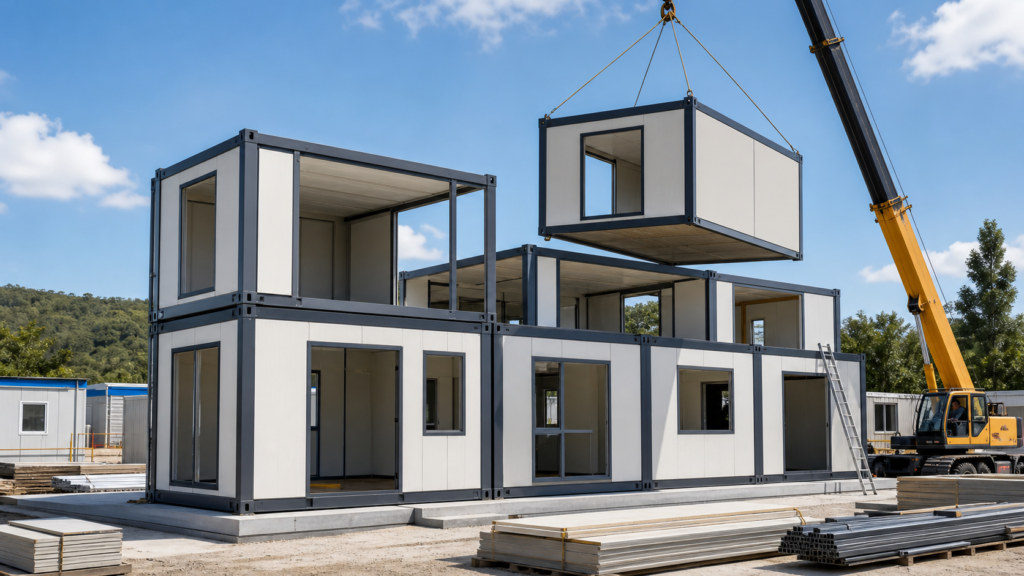
A Detachable House is a smart building option for projects that need speed, flexibility, and practical cost control. Unlike traditional construction, many detachable house systems are produced in a factory, packed efficiently, transported to the site, and assembled with bolts, steel frames, insulated panels, windows, doors, and utility connections. This makes the building easier to ship, easier to install, and easier to expand when the project changes.
For buyers who need temporary offices, worker accommodation, containerized dormitories, site camps, schools, clinics, shops, or small residential units, a Detachable House can offer a balance between fast delivery and long-term usability. It is not just a temporary box. With the right design, insulation, layout, and material choices, it can become a comfortable and reliable space for many different industries.
1. What Is a Detachable House?
A Detachable House is a prefabricated building system that can be assembled, disassembled, transported, and reused more easily than many traditional building types. The structure is usually based on a steel frame, wall panels, roof panels, floor system, doors, windows, and connection parts. Many systems use bolted connections, which makes installation and future relocation more practical.
This type of building is closely related to modular house and prefab container house systems. The main difference is that a detachable system is often designed for efficient packing and reassembly. Instead of shipping a fully completed unit with a lot of empty interior space, the parts can be packed more compactly to improve transport efficiency.
For export buyers, this can be a major advantage. A flat pack or detachable container house can allow more units to fit into one shipping container, helping reduce the shipping cost per room or per building.
2. Faster Installation for Urgent Projects
Speed is one of the strongest reasons to choose a Detachable House. Many parts are prepared in the factory before shipment, so the site team does not need to start from raw materials. Once the foundation is ready, the building can be assembled step by step using the supplied frame, panels, roof, windows, doors, and accessories.
This is useful for projects that cannot wait for a long construction schedule. Construction companies may need worker dormitories quickly. Industrial parks may need temporary offices. Schools may need extra classrooms. Mining, energy, and infrastructure projects may need accommodation in remote locations.
The Modular Building Institute explains modular construction as a process where buildings are constructed off site under controlled plant conditions and then assembled on location. A detachable building follows the same practical idea: move more work into organized production and reduce time-consuming work on site.
3. Lower Transport Pressure
Transport cost can become a large part of any international building project. A fully assembled container unit is simple to deliver, but it also ships a lot of empty space. A Detachable House can reduce this problem because panels, frames, roof parts, and accessories can be packed together more efficiently.
For buyers who need many rooms, this difference matters. A containerized dormitory project may require dozens or hundreds of units. If the packing method is efficient, the total number of shipments can be reduced. This helps control ocean freight, inland transport, and unloading work.
However, transport planning should be done carefully. Buyers should ask the supplier for packing volume, loading quantity, container type, weight, and installation drawings before confirming the order. Good packing is not only about fitting more parts into a container. It also needs to protect wall panels, doors, windows, and painted steel parts during shipment.
4. Flexible Layouts for Many Applications
A Detachable House can be used for many building types. A single unit can become a guard room, small office, shop, storage room, or temporary living space. Multiple units can be connected to create larger buildings such as dormitories, classrooms, clinics, canteens, or project offices.
For a worker camp, the layout may include dormitory rooms, shared toilets, shower rooms, laundry areas, kitchens, and dining halls. For a prefab container house used as a residence, the design may include bedrooms, a living room, a bathroom, a kitchen, and a small terrace. For commercial use, the design may focus on glass doors, customer access, signage space, and interior display areas.
The layout should always begin with the real use of the building. A beautiful design is not enough if the room size, circulation, plumbing, ventilation, or storage areas do not match daily use.
5. Better Control of Materials and Quality
Because many detachable house components are made in a factory, the supplier can control materials and production steps more consistently. Steel frames can be cut, welded, drilled, and painted under organized conditions. Wall panels can be selected according to the climate and project budget. Doors and windows can be prepared before the shipment leaves the factory.
This factory process helps reduce random site work. It also makes inspection easier. Buyers can ask for photos, production videos, packing lists, and quality checks before shipment. For a large project, this can reduce uncertainty and make the final installation more predictable.
Important quality points include steel thickness, anti-rust treatment, panel insulation, roof waterproofing, floor strength, door and window quality, electrical standards, and connection details. A Detachable House is only as reliable as the parts and the installation method behind it.
6. Comfort Depends on Insulation and Ventilation
A Detachable House should be designed for the local climate. In hot regions, the roof and walls need proper insulation to reduce indoor heat. In cold regions, thicker insulation, sealed windows, and good floor design are important. In rainy areas, roof drainage and waterproof joints should receive extra attention.
Comfort also depends on ventilation. Dormitories, kitchens, bathrooms, and offices all need fresh air. If moisture cannot escape, the interior may feel uncomfortable and materials may age faster. Windows, exhaust fans, air conditioning positions, vents, and drainage should be planned before production.
For buyers comparing different suppliers, the cheapest wall panel is not always the best option. A better insulated prefab container house may cost more at the beginning, but it can improve user comfort and reduce later complaints.
7. Cleaner Sites and Less Material Waste
A detachable building system can help make the project site cleaner. Since many parts are pre-made and packed according to the design, there is usually less cutting, welding, and material storage on site. This is helpful for city projects, industrial sites, schools, and remote camps where site management is difficult.
The U.S. EPA provides guidance on sustainable management of construction and demolition materials, including reducing, reusing, and recycling construction materials. A Detachable House supports this direction when it is designed for efficient material use, organized packing, and possible reuse at another site.
If a project only needs temporary space, reusability is especially valuable. Instead of demolishing a building after one use, the owner may be able to remove, transport, and rebuild the structure in another location.
8. Easier Expansion and Relocation
Project requirements often change. A site office may need more meeting rooms. A dormitory may need extra beds. A school may need more classrooms. A Detachable House makes expansion easier because the system is based on repeatable modules and connection details.
Relocation is another advantage. If the building is not permanently fixed to one site, the owner may move it when the project ends. This is useful for construction companies, mining projects, temporary medical facilities, disaster relief projects, and seasonal business operations.
To make relocation easier, the first design should consider lifting points, connection parts, panel protection, utility access, and future disassembly. If the building is assembled too randomly, it may be difficult to move later.
9. What to Check Before Buying
Before ordering a Detachable House, buyers should check more than the outside appearance. The most important questions are practical:
Structure
Ask about the steel frame, column thickness, beam design, anti-rust treatment, wind resistance, and connection method.
Panels
Confirm the wall panel material, insulation thickness, fire performance, sound control, and exterior finish.
Utilities
Check electrical standard, socket position, lighting, plumbing, drainage, air conditioning openings, and bathroom details.
Packing and Shipping
Ask how many units fit in one container, how the parts are protected, and whether a packing list is provided.
Installation Support
Request installation drawings, videos, manuals, and technical support. For large projects, supplier guidance can save time and reduce mistakes.
Conclusion
A Detachable House is a flexible building solution for buyers who need fast installation, efficient transport, adjustable layouts, and future reuse. It can be used as a modular house, prefab container house, mobile container house, or containerized dormitory depending on the project requirement.
The best result comes from early planning. Before choosing a supplier, think about the building purpose, local climate, transport route, installation team, utility connections, and long-term use. When these details are clear, a Detachable House can become a practical and cost-effective solution for many building projects.
FAQ
What is a Detachable House?
A Detachable House is a prefabricated building system that can be assembled, disassembled, transported, and reused. It usually includes a steel frame, wall panels, roof panels, floor system, doors, windows, and connection parts.
Is a detachable house suitable for long-term use?
Yes. A detachable house can be used for long-term projects when the structure, insulation, waterproofing, foundation, and installation are designed correctly.
What is the difference between a detachable house and a container house?
A container house may be shipped as a complete unit, while a detachable house is often packed as separate parts for efficient transport and assembled on site.
Can a detachable house be moved to another site?
Yes. Many detachable house systems are designed for relocation, but the ease of moving depends on the structure, connection method, utility setup, and how carefully it was installed.
What should buyers check before ordering a detachable house?
Buyers should check the steel frame, wall panels, insulation, roof system, waterproofing, doors, windows, electrical standard, plumbing, packing method, shipping quantity, and installation support.