
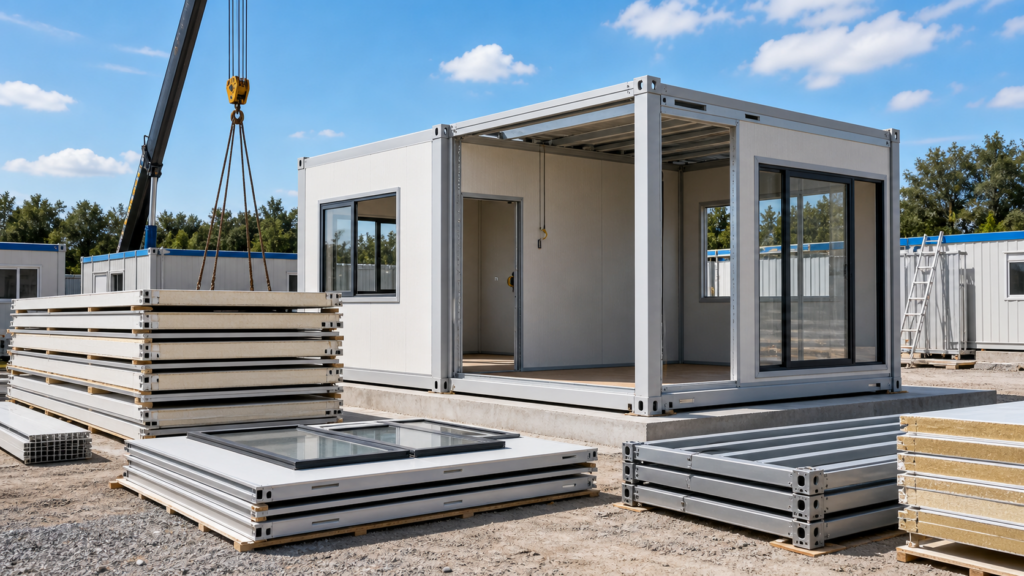
A Flat Pack Container House is one of the most practical building solutions for export projects, temporary accommodation, worker camps, offices, schools, clinics, and other fast construction needs. Unlike a fully assembled container unit, a flat pack system is designed to be packed compactly, shipped efficiently, and assembled on site with steel frames, insulated wall panels, roof panels, floor sections, windows, doors, and accessories.
For international buyers, this matters a lot. Shipping cost, installation speed, site conditions, and long-term maintenance all affect the real project budget. A well-designed Flat Pack Container House can help reduce transport pressure, improve loading quantity, and create a flexible space that can be used for many different applications.
1. What Is a Flat Pack Container House?
A Flat Pack Container House is a prefabricated building system that is manufactured in parts and packed flat for transportation. The main components usually include the top frame, bottom frame, columns, wall panels, roof system, floor system, doors, windows, electrical parts, and installation accessories.
After the goods arrive at the project site, the installation team assembles the parts into a complete building. The system is similar to a detachable container house, but the key selling point is packing efficiency. Instead of shipping empty interior space, the parts are stacked and arranged to save container volume.
This makes flat pack systems attractive for overseas projects where ocean freight is a major cost. A buyer who needs many rooms for a containerized dormitory, site camp, or temporary office can often save money by choosing a flat pack method.
2. Why Flat Pack Design Is Useful for Export
Export projects often face a simple problem: the product price may be acceptable, but the shipping cost can become expensive. A fully assembled container house is convenient, but it takes up a lot of space during transport. A Flat Pack Container House helps solve this problem because the parts can be packed more tightly.
This can increase loading quantity and reduce the shipping cost per unit. For large projects, even a small improvement in packing efficiency can make a big difference in the total budget.
Flat pack design also makes inland transport easier in some regions. If the project site is far from the port, compact packing can help reduce the number of trucks required. This is especially useful for remote mining sites, construction camps, infrastructure projects, and temporary housing projects.
3. Faster Installation Than Traditional Construction
A Flat Pack Container House is not only about shipping. It is also designed for fast installation. Many components are prepared in the factory before delivery, including steel parts, wall panels, window openings, door openings, roof details, and accessory holes. This reduces the amount of cutting and modification required on site.
The Modular Building Institute is a useful source for understanding how modular construction moves building work into a more controlled production process. For buyers, the practical benefit is clear: when more work is completed before the goods arrive, the site team can finish the building faster.
Fast installation is important for worker camps, emergency housing, construction offices, and projects with tight schedules. The building can often be installed after the foundation is ready, making the whole process easier to manage.
4. Flexible Layouts for Different Uses
A Flat Pack Container House can be used alone or combined with other units. A single unit can become a small office, guard room, shop, storage room, or compact living space. Multiple units can be arranged side by side or stacked to create larger buildings.
For a containerized dormitory, the layout may include repeated rooms, shared toilets, shower areas, laundry rooms, and corridors. For a prefab container house used as a residence, the layout may include bedrooms, a bathroom, a kitchen, and a living room. For office use, the design may include meeting rooms, open work areas, reception space, and storage.
This flexibility is one reason flat pack systems are popular in international projects. The same basic structure can be adjusted for different markets and different site needs.
5. Factory Quality Control
Because a Flat Pack Container House is produced in a factory, the supplier can control material preparation, steel cutting, welding, painting, panel production, packing, and inspection more consistently. This is especially important for buyers who are purchasing from another country and cannot visit the factory every day.
Before shipment, buyers should ask for production photos, packing photos, inspection details, and installation drawings. Quality control should cover the steel frame, anti-rust treatment, wall panel thickness, insulation material, roof waterproofing, floor strength, window quality, door quality, and accessory list.
A good supplier will not only sell the building. They will also help the buyer understand how the parts are packed, how the building should be assembled, and what tools or workers are needed on site.
6. Better Site Management
Traditional construction often requires many materials to be stored on site. There may be cutting, welding, painting, mixing, and long-term waste handling. A flat pack system can make the site cleaner because most parts arrive ready for assembly.
This is useful for projects in industrial parks, schools, active factories, remote camps, and small sites with limited storage space. Organized site work can reduce confusion, improve safety, and help the installation team work more efficiently.
The U.S. EPA provides guidance on sustainable management of construction and demolition materials. A flat pack building system can support cleaner project planning by reducing unnecessary site waste and making material handling more organized.
7. Comfort Depends on Insulation and Details
A Flat Pack Container House should not be judged only by its frame. Comfort depends on insulation, ventilation, roof design, floor design, windows, doors, and air conditioning planning. If the project is in a hot region, roof insulation and wall panels should reduce heat. If the project is in a cold region, thicker insulation and better sealing become more important.
The U.S. Department of Energy’s Building Energy Codes Program is a useful reference for understanding why building envelope details such as insulation and windows matter. Even when a project is outside the United States, the basic idea is still useful: comfort and energy performance should be considered before production.
Ventilation is also important. Dormitories, offices, kitchens, and bathrooms need fresh air and moisture control. A good design should include window positions, exhaust fans, air conditioning openings, and drainage planning from the beginning.
8. Easier Expansion and Relocation
Many flat pack projects are not fixed forever. A construction company may need accommodation for one project and then move the buildings to another site later. A school may need temporary classrooms for a few years. A business may want an office that can be expanded as the team grows.
A Flat Pack Container House can support these needs because the system is based on repeatable modules. Units can be added, rearranged, or moved depending on the structure and installation method.
To make future relocation easier, the project should be planned carefully. Keep clear installation drawings, protect spare parts, avoid random site modifications, and make sure utility connections can be disconnected safely.
9. What Buyers Should Confirm Before Ordering
Before buying a Flat Pack Container House, it is important to check both product details and project conditions.
Packing Quantity
Ask how many units can fit into one shipping container and how the parts are protected during transport.
Steel Structure
Confirm frame thickness, column design, beam strength, anti-rust treatment, and connection method.
Wall and Roof Panels
Check panel material, insulation thickness, fire performance, waterproofing, and exterior finish.
Doors and Windows
Confirm window size, glass type, door material, locks, sealing, and hardware quality.
Installation Support
Ask for installation drawings, videos, manuals, tool lists, and technical support. For large projects, supplier guidance can save a lot of time.
Conclusion
A Flat Pack Container House is a strong choice for export projects because it combines compact packing, fast installation, flexible layouts, and practical cost control. It can be used as a modular house, detachable container house, mobile container house, containerized dormitory, office, classroom, clinic, or temporary accommodation.
The best result comes from early planning. Buyers should confirm the building purpose, local climate, layout, insulation, packing method, shipping route, foundation, and installation team before placing an order. When these details are clear, a Flat Pack Container House can become a reliable and efficient solution for many modern building projects.
FAQ
What is a Flat Pack Container House?
A Flat Pack Container House is a prefabricated building system shipped as compact parts and assembled on site. It usually includes steel frames, wall panels, roof panels, floor sections, doors, windows, and accessories.
Is a flat pack container house suitable for export?
Yes. Flat pack systems are often suitable for export because they can improve loading quantity and reduce shipping cost compared with fully assembled units.
How long does it take to install a flat pack container house?
Installation time depends on the project size, foundation, workers, tools, and site conditions. Small units can be installed quickly, while larger projects need more planning.
Can flat pack container houses be customized?
Yes. Buyers can usually customize layout, size, wall panels, windows, doors, roof system, floor material, electrical design, plumbing, and exterior color.
What should buyers check before ordering?
Buyers should check packing quantity, steel structure, insulation, roof waterproofing, doors, windows, electrical standards, plumbing, installation drawings, and supplier support.